
The Michigan Wildlife Council: Leaders in Protecting Michigan's Legacy of Conservation

As outdoor enthusiasts flock to Michigan's forests, trails, and waterways this fall, we invite you to recognize the sportsmen and sportswomen leading the charge in protecting Michigan's legacy of conservation: the Michigan Wildlife Council.

"Now this...this is what it's all about."
When words fail to adequately capture a sensation, the soul knows how to deliver. Chemists allocate the feeling to a mix of serotonin and dopamine, but your very essence experiences that familiar rush of nostalgia right as the truck starts up on a crisp fall morning. Or the boat starts humming in the pre-dawn mist. The exact moment that a blazing sun breaks through the morning dawn, illuminating a world of red, orange, and yellow.
For Michigan's hunting and fishing faithful, fall is full of traditions that summon this nostalgia. No matter how many years - or generations - pass by, time always seems to stand still at your trusted tree stand, secret fishing hole, or favorite trail. As the ziiiiip and plunk of the fishing line breaks the morning silence, every memory from each cast comes rushing back. The immortal, living legacy of those who first taught you to cast a line, carried on indefinitely by the next generation waiting increasingly impatiently to take the rod.
For me personally, every time that I climb into my favorite tree stand during whitetail deer season, I express gratitude for everything contributing to that precise moment. For the tree that supports me, the surrounding environment that supports abundant life, the mentors that patiently taught me how to hunt, and a state that recognizes the incomprehensible value that conservation provides to its people, wildlife, and natural resources.
From the fishing piers of downtown Detroit to the rugged north woods of the Upper Peninsula, the great state of Michigan has invested heavily in continuing its tradition of conservation throughout the Great Lakes State. Specifically, the Michigan Wildlife Council has been deputized by the governor's office to spearhead the effort to preserve Michigan's great outdoor heritage for future generations.
Despite their success, recent data shows that less than a quarter of Michigan's outdoor recreationists are familiar with those entrusted with protecting Michigan's legacy of conservation. That changes now, with this long-overdue article.

A Heritage of Conservation: The Complicated History of Regulated Hunting, Fishing, and Trapping in Michigan
Hunting, fishing, and other conservation-related activities across Michigan date as far back as the known history of Michigan itself. Before the arrival of Europeans to the Great Lakes region, Michigan’s three largest tribes - the Ojibwe (also called Chippewa), Odawa (also called Ottowa), and the Potawatomi - relied predominantly on hunting, fishing, and trapping across Michigan's abundant forests and waterways for both sustenance and cultural significance. The arrival of European-descendent settlers in the 1700s and 1800s brought drastic changes to Michigan's natural ecosystem, including significant natural resource degradation brought on by unregulated development, logging, and market hunting and angling.
Fortunately, the pioneers of modern conservation recognized the threat facing Michigan's natural resources. In 1875, the Michigan Sportsman Association formed in Detroit to create a unified effort to prevent what they realized was a wanton destruction of the northern Michigan deer herd. In 1887, Michigan deputized William Alden Smith as its first game warden responsible for enforcing fish and game regulations. The first deer license regulations went into effect in 1895, prompting the eventual creation of the Department of Conservation - later renamed the Department of Natural Resources - in 1921 and a century of successful conservation activism.
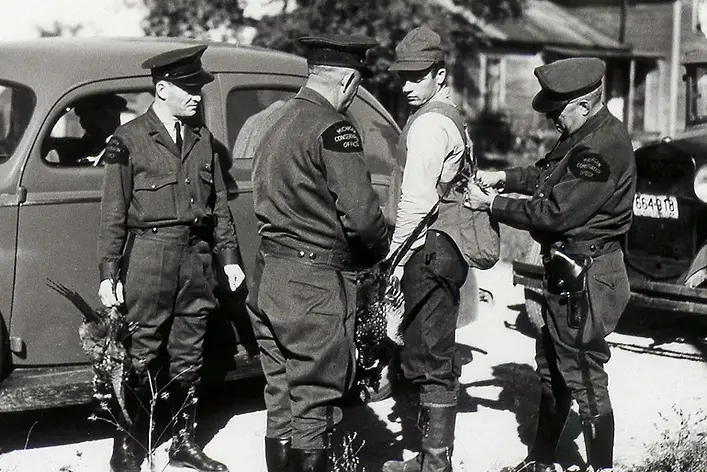
While conservation activities remained synonymous with recreation throughout most of the 20th century, a steady decline of hunter participation from 1982 until 2010 eroded the ecological, fiscal, and cultural benefits that hunting and trapping bestowed upon Michigan. Although not as drastic, the relative numbers of anglers has also declined slowly over the past 40 years. Available data from leading survey research firms like Responsive Management demonstrate that the percentage of Americans who hunt and fish is expected to continue to decline, thereby threatening the revenues and impact of state wildlife agencies.
Total Number (millions) | 1960 | 1982 (peak hunting year) | 2021 (peak fishing year) | 2022 | Change (1960-2022) |
Hunting licenses sold in U.S. | 14.0 | 16.7 | 15.9 | 15.9 | 13.5% |
Fishing licenses sold in U.S. | 19.1 | 30.0 | 32.2 | 31.0 | 62.3% |
U.S. Population | 180.7 | 231.7 | 332.1 | 333.3 | 84.4% |
Data courtesy of Wildlife for All
This concerning trends supports the rationale behind why most state wildlife agencies have embraced "R3 efforts" to “recruit, retain and reactivate” hunters and anglers in order to boost the number of license buyers. For Michigan, that effort has been statutorily embodied within the Michigan Wildlife Council: the modern protectors of Michigan's legacy of conservation.

Conservation Proclamation: The People's Mandate for the Michigan Wildlife Council
With public perception of hunting, fishing, and trapping free-falling on a nation-wide scale, the Michigan State Legislature decided that immediate action was needed. On September 18th, 2013, Representative (now Senator) Jon Bumstead introduced House Bill No. 4993 that first contemplated the establishment of the Michigan Wildlife Council.
The mandate of this new government body would eventually read as follows: "Develop and implement, in conjunction with a third-party marketing or advertising agency, a comprehensive media-based public information program to promote the essential role that sportsmen and sportswomen play in furthering wildlife conservation and to educate the general public about hunting, fishing, and the taking of game."
That mandate further required the Michigan Wildlife Council to educate the public that hunting, fishing, and the taking of game are associated with the following:
Necessary for the conservation, preservation, and management of this state's natural resources;
A valued and integral part of the cultural heritage of this state and should forever be preserved; and
An important part of this state's economy.
On December 21, 2013, Governor Snyder signed the bill into Michigan State Law. With the stroke of his pen, the Governor not only codified the existence of the Michigan Wildlife Council, but a directive from the people of Michigan to advocate for the protection of its most at-risk resources: its fish and wildlife.

Legacy Protectors: Measuring the Impact of the Michigan Wildlife Council
A lot has changed in Michigan since the Michigan Wildlife Council was entrusted with protecting Michigan's legacy of conservation nearly 13 years ago. For one, the successor of the Governor who signed the legislation has nearly completed her two terms in office. The Detroit riverfront has experienced a glorious revitalization. Our state weathered an unprecedented pandemic, and consequently our outdoor recreation industry has flourished.
Throughout these trials and tribulations, Michigan's wildlife and natural resources have remained a constant backdrop to our state's ambience. And despite the logistical hurdles of Covid-19, the Michigan Wildlife Council has remained a steady - and successful - advocate for their conservation.

With the aid of a cutting-edge multimedia marketing agency, the 9-member Michigan Wildlife Council has utilized its annual allocated budget ($1.6 million generated from hunting and fishing licenses) to launch a broad marketing campaign in furtherance of its mandate. The 2026-27 installment of the Council's "Protecting Michigan's Legacy" campaign includes a mix of the following:
Engaging social media marketing content.
Strategically-placed video marketing.
Billboards at high-traffic interstate locations.
Partnering with mission-aligned third party marketing outlets.
With regard to the success of the Michigan Wildlife Council's efforts, available data from a Responsive Management 2025 survey demonstrably supported a strong correlation (79%) between outdoor enthusiasts who have both (i) seen the Council's marketing materials and (ii) approve of regulated hunting and fishing. The report also found that Michiganders lead the country in general support of regulated hunting (75%) and fishing (82%).

The Next Frontier: The Significance of Metro Detroit for Michigan's Legacy of Conservation
So...with all of the success of the Michigan Wildlife Council over the last 13 years, why are we highlighting the Council's mandate for Expedition Detroit's audience?
Succinctly put, because the future of conservation in Michigan starts in Southeast Michigan.
Just as Michigan's historic conservation moments began in the City of Detroit, the Responsive Management survey also demonstrates that our region provides the greatest opportunity for expansion of conservation activism. Per the report, the survey respondents that disapproved the most of regulated hunting included the following:
Those who had never heard of the Michigan Wildlife Council (12%);
Those who reported their ethnicity as black (12%);
Those who reported their age as 25-44 years old (11%); and
Those who reported living in Metro Detroit (11%).
For Team Expedition Detroit, this data provides a once-in-a-lifetime opportunity to partner with the Council - and serve the people of Michigan - through our platform. Long-time readers of our content know that we have long advocated for the ecological, environmental, and social benefits of conservation-based recreation within our region. Metro Detroit's overpopulation of deer, abundant waterways, plethora of publicly-accessible land, and available cultural resources like the DNR Outdoor Adventure Center equate to a generational opportunity to enact Michigan's next golden age of conservation.

Coming fall 2026, the Michigan Wildlife Council's newest public slogan will be "The Tradition is the Trophy." As you venture out into the woods this October, or drop a line into a frozen lake this February, or call in a gobbler next May, we're certain that you'll resonate with this slogan too. Before knocking an arrow or casting a line, we invite you to pause for a moment and express gratitude for those ardent conservationists that have protected your right to enjoy these traditions.
Better yet, we hope that you join the growing number of Michiganders heeding the Michigan Wildlife Council's call to protect Michigan's legacy of conservation for generations to come.
This is a sponsored article produced by and in collaboration with the Michigan Wildlife Council. Expedition Detroit is proud to partner with private enterprises and public organizations like the Michigan Wildlife Council that share our core values.


Comments